
Camber Policy Deep Dive
Inside the CMS ABA Toolkit: Why These Changes Matter
CMS sent state Medicaid directors a 170-page ABA toolkit on August 4, 2026. Its recommendations build on policies, audits, and litigation already underway in individual states.
Source: CMS State Medicaid & CHIP ABA Toolkit, released August 4, 2026, cross-checked against current state bulletins and industry reporting as of August 2026.
Medicaid and CHIP spending on ABA therapy increased from $421 million in 2021 to $2.1 billion in 2025, a 421% increase, while the number of autistic children receiving services grew 67% over the same period. North Carolina's payments increased more than 400% since 2022. Nebraska's increased roughly 1,700%, and Indiana's roughly 2,800%. The difference between spending and service growth provides important context for the 170-page toolkit CMS sent to state Medicaid directors on August 4, 2026.
Top 25 states by total Medicaid and CHIP payments for applied behavior analysis services, 2023 to 2025
The toolkit recommends documentation checklists, hour thresholds, licensure and accreditation standards, and a new federal dashboard to help states distinguish legitimate growth from improper billing. Most recommendations draw on state policies, audits, or litigation already on the record. Value-based payment would go further by changing provider incentives. No state has implemented it, and CMS gives it four paragraphs on page 74 without a proposed timeline.
01
Audits and service limits
The audit wave already has numbers behind it
Documentation flags define what auditors check for. Hour intensity defines how much treatment triggers a look in the first place. CMS published six specific patterns and three severity-linked hour thresholds, replacing the old 40-hour default. Audits have already uncovered $599.8 million using patterns like the first one, and four states built their own version of the second before CMS ever put anything in writing.
Treatment documentation flags for potentially erroneous or improper billing.A federal audit found $77.8 million in improper ABA payments in Colorado. Four completed OIG audits have recovered money using the documentation patterns CMS has now issued as guidance for every state. Those patterns include overlapping treatments, hours that do not taper as outcomes improve, identical notes across clients, group therapy exceeding 10% of treatment time, staffing ratios without clinical justification, and limited caregiver engagement. The findings were $56 million in Indiana, $18.5 million in Wisconsin, and $45.6 million in Maine. With Colorado included, the total is nearly the same as the $198.4 million cited in the CMS toolkit.
Confirmed improper payments are one part of the audit findings. Auditors also identify payments they cannot confirm as either proper or improper. Colorado's audit found an additional $207.4 million in potentially improper payments, bringing its combined figure to $285.2 million. Wisconsin found another $94.3 million. Using HHS-OIG's combined reporting of improper and potentially improper payments, the total is $599.8 million, roughly three times the confirmed figure most reporting has cited.
Massachusetts isn't part of that $198.4 million. Its Inspector General independently found $17.3 million in overpayments tied to unmet supervision requirements in 2024. Nebraska and Nevada round out the toolkit's list of seven states under review. The U.S. House Energy and Commerce Committee has also opened its own investigation into 11 states over ABA program integrity, mostly a different set than the seven already audited.
State auditors identified these patterns in completed cases and recovered improper payments before CMS formalized them as guidance. The toolkit consolidates findings developed independently by seven state audit teams and makes them available to every state.
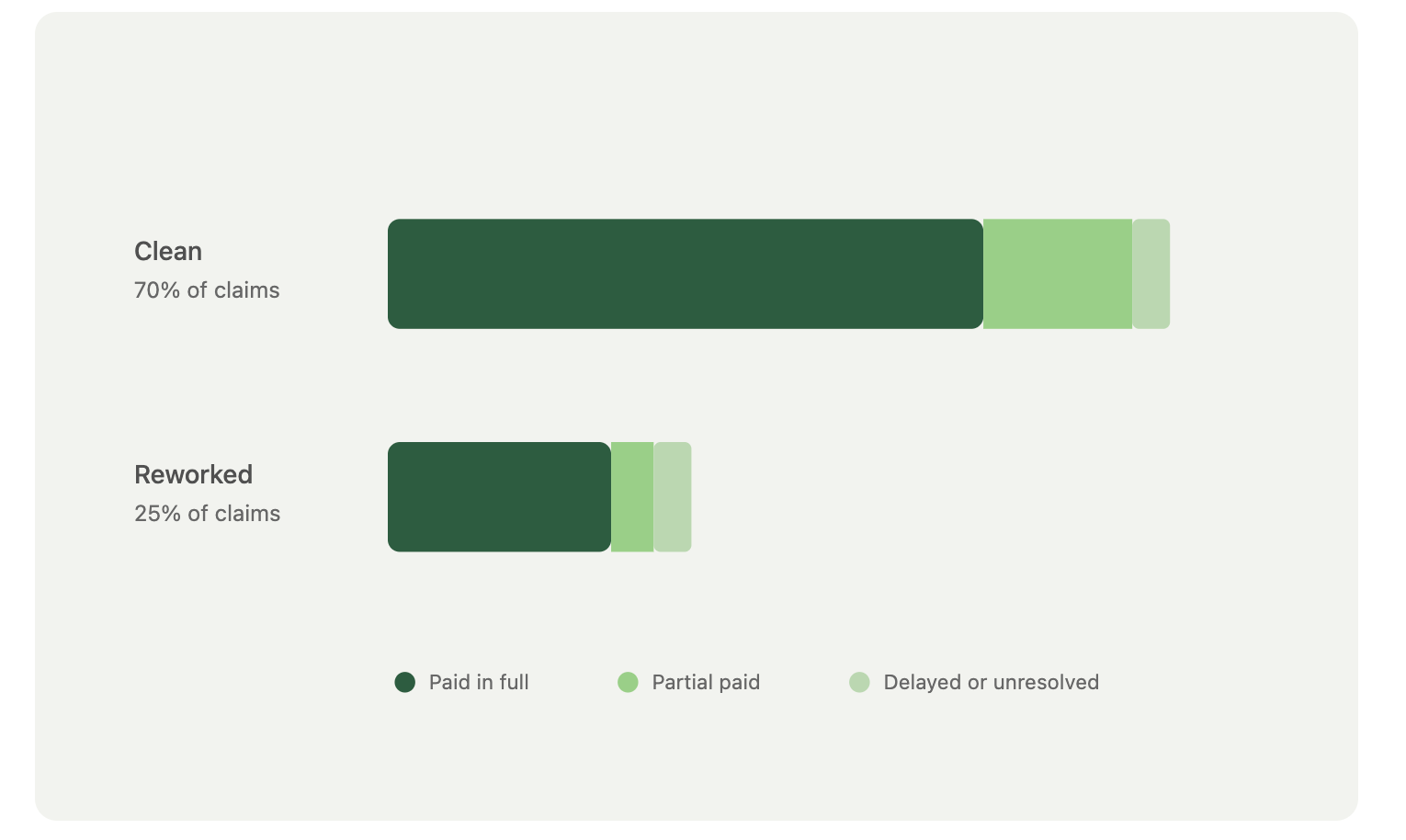
The guidance also targets a failure point that was already costly for clinics. In a collaboration with a16z, Camber analyzed ABA claims and found that roughly 72% go through clean, while the remaining 28% require additional work from the clinic. Documentation and information gaps are the largest cause of that rework, accounting for close to 20% of denied dollars and exceeding coverage and credentialing issues. CMS formalized guidance around a problem that was already driving denials and administrative cost.
Frequency and intensity of ABA services.CMS recommends weekly thresholds of 10 hours for DSM-5 severity level 1, 20 hours for level 2, and 30 hours for level 3. No previous federal document has tied ABA intensity to a clinical severity scale. States and providers have generally relied on clinical judgment or a flat cap.
The toolkit also addresses two billing practices. It recommends breaks between consecutive treatment units rather than back-to-back sessions running all day. It also discourages consolidated billing, where every 15-minute unit from a full day appears under one claim line and obscures how the hours were delivered.
Together, these recommendations address the 40-hour weekly caseload CMS now calls "not a best practice." Four states acted before CMS issued its guidance. North Carolina requires reapproval every three months above 16 hours a week. Virginia requires activity-by-activity justification past 20. Indiana capped hours in 2026 and proposed a lifetime limit. Nebraska also imposed a cap. CMS used those states' experience to develop a severity-linked framework that others can adopt.
02
EVV and telehealth
States already ran this experiment
The next two recommendations address care delivered outside a clinic. Electronic Visit Verification (EVV) checks whether a home visit actually happened. Telehealth rules determine how much treatment can happen on a screen instead of in a room. Colorado turned on EVV in 2020 and still enforces it today, prepayment denials included, while Florida tried the identical rollout the same year and ended up sued into reversing it by 2022. Telehealth split along similar lines without any federal push, 28 states already leaning restrictive against 22 that don't.
Validating service delivery with Electronic Visit Verification.Electronic Visit Verification is a system that captures the who, what, when, and where of a home-based visit automatically, service type, date and time, location, the specific provider, the specific patient, instead of relying on a provider's self-reported notes. Federal law has only ever required it for personal care and home health services. The toolkit recommends, without mandating, that states extend it to home-based ABA too, given how much of that care happens in the home rather than a clinic.
Colorado and Florida both introduced EVV for in-home behavioral therapy in 2020, but their programs developed differently. Colorado has denied claims without a matching visit record since 2022. Florida suspended its pilot that year after a provider sued over claims invalidated after submission. States considering EVV now have an active operating model in Colorado and a record of Florida's legal and implementation problems.
Colorado
Still enforced
Colorado introduced EVV for in-home behavioral therapy in 2020. Since 2022, claims without a verified visit record have been denied.
Florida
Suspended
Piloted the identical system the same year. By 2022, shut it down after a provider sued, alleging claims were invalidated after submission.
Telehealth and telehealth supervision.The toolkit sets three specific rules where states previously had one general telehealth policy. Diagnosis should happen in person, except in narrow, well-justified cases. Direct treatment delivered by an RBT over video should be permitted less freely than in-person care. Supervision by telehealth has to be live video, not a recorded check-in, and can't be the only form of supervision a BCBA provides.
The toolkit's June 2026 count found loose telehealth rules in 22 states and more restrictive rules in 28. That count predates the new CMS guidance. Most states had covered diagnosis, direct treatment, and supervision under one general telehealth policy; CMS now provides a separate standard for each activity.
Access state-by-state telehealth requirements alongside reimbursement data in Camber's Payer Rates Data tool.
03
Licensure and accreditation
Raising the bar on who can bill
Before the toolkit, most Medicaid programs focused on individual credentials. A BACB certification and state registration were enough to bill independently in 39 states plus D.C., while organizational accreditation remained uncommon. CMS now recommends state licensure, individual NPIs, minimum supervision standards, and third-party accreditation for agencies.
ABA provider qualifications.CMS recommends state licensure rather than accepting BACB certification as a substitute, an individual NPI for every provider even when billing under a supervisor, and at least 25% of each caseload's supervision personally provided by a BCBA. In 39 states plus D.C., BACB certification and state registration are currently sufficient to bill Medicaid independently.
North Carolina departed from the prevailing approach in 2026 by barring out-of-state BCBA supervisors from enrolling in NC Medicaid. Minnesota is developing a provisional organizational license that ties Medicaid participation to state inspection authority and mandatory ownership disclosure, a requirement that also supports the toolkit's focus on ownership transparency. Because licensing changes may proceed administratively, this requirement could spread faster than reforms that require legislation.
Credentialing gaps are already the second-largest driver of claims rework in specialty care billing data, right behind documentation. Tightening who's allowed to bill raises the compliance bar and presses directly on a friction point clinics are already paying for on every claim cycle.
Organizational accreditation requirements.CMS calls third-party accreditation through ACQ, CARF, or the Joint Commission a best practice for ABA agencies. Some payer networks already require it for participation or higher reimbursement. About 50 ABA organizations currently hold ACQ accreditation nationwide, while two states have made accreditation mandatory.
Two states have imposed deadlines on enrolled providers, while only about 50 ABA organizations currently hold ACQ accreditation nationwide. CMS calls accreditation a best practice, but Massachusetts and Indiana already treat it as a requirement. Other states may consider similar mandates.
04
Ownership and referrals
How CMS approaches ownership and referrals
These two recommendations address the financial interests behind a child's care. Ownership monitoring identifies who controls and benefits from the provider organization. Self-referral safeguards examine whether the clinician making a diagnosis has a financial interest in where the child is sent for treatment. CMS quantified private equity consolidation for the first time and focused its recommendations on greater visibility rather than ownership limits. Minnesota is the only state developing a comparable ownership requirement, and no state has an ABA-specific self-referral rule.
Corporate ownership structures.CMS reports that 12 private equity-backed chains have acquired 574 ABA sites since 2015 and employ more than 30,000 workers. This is the first time those consolidation figures have appeared in a federal document. CMS did not take a position on private equity ownership itself.
CMS quantifies the trend without recommending direct limits on private equity ownership. Instead, it calls for disclosure within 35 days of an ownership change, OIG exclusion screening for new owners, revalidation after an acquisition, and monitoring of staffing and caseload growth. Minnesota's provisional licensure is the only comparable state mechanism currently in development.
Self-referral safeguards.CMS recommends that states require disclosure of financial or ownership ties between the clinician who diagnoses a child and the ABA provider who treats them, prohibit compensation tied to referral volume, and monitor referral patterns for outliers, applying Stark Law's self-referral logic to ABA for the first time. No state has an ABA-specific self-referral rule yet, so this guidance is largely prospective.
Implementation may not require a lengthy statutory process. Stark Law already governs Medicaid broadly, so states could extend an existing framework instead of creating new authority. Together, the self-referral and ownership guidance indicates that CMS expects financial relationships between diagnosing clinicians and treating providers to be documented and monitored.
05
Analytics and prepayment
Building the analytics states didn't have
MEVIA flags potential improper billing after payment. A prepayment review would hold a claim before payment, but no state currently runs an ABA-specific program. MEVIA's weekly threshold converts to 40 treatment hours, which is 10 hours above CMS's recommended ceiling for level 3 severity.
CMS emerging-vulnerability analytics.CMS set MEVIA's outlier thresholds at 32 units a day and 160 units a week. These are the first federal figures defining an ABA billing outlier. The dashboard launched in June 2026 to flag providers that cross them.
CMS has not published which states have opted in. HFPP and MEVIA participation is voluntary, but states have a financial incentive to participate: those that decline may have to fund comparable fraud-detection analytics themselves.
At 15 minutes a unit, 32 units a day equals 8 hours and 160 units a week equals 40 hours. That is the same caseload CMS calls not a best practice, yet it exceeds North Carolina's 16-hour reapproval threshold, Virginia's 20-hour justification threshold, and CMS's own 30-hour ceiling for level 3 severity. MEVIA's automated threshold is higher than each of those clinical review thresholds.
About 20 hours
30 hours
40 hours
Additional state review
CMS clinical ceiling
MEVIA flag
Prepayment medical review.Zero states run a named, ABA-specific prepayment review program today. CMS cites Medicare's Targeted Probe and Educate model as a possible reference, although it was designed for a different program.
Michigan's 2026 prior-authorization overhaul offers a partial comparison. It requires standard decisions within seven calendar days but allows faster denials when documentation is incomplete. A true prepayment hold could have substantial cash-flow effects because payment would be withheld pending review.
Camber's analysis with a16z shows that claims rework already has material financial effects. After a single resubmission, clinics ultimately recoup less than half of the claim's value. After three or four rounds of review, that falls to roughly a quarter, often months after the service was delivered. A prepayment hold could shift those cash-flow effects earlier in the process.
100%
As submitted
48%
After one resubmission
25%
After three to four rounds
06
Outcomes and payment
Outcomes, payment, and the piece states are missing
Outcome assessments supply the data required for value-based payment. Florida already requires two named instruments with every prior-authorization request, creating a foundation for each of CMS's four proposed payment models. No state operates a bundled ABA model today, but Florida has already established one of its central data requirements.
Evidence-based outcome assessments.Florida requires full Vineland-3 and BASC-3 scoring reports with every prior authorization request and does not accept provider-built tracking tools instead. Georgia now bases reauthorization on measurable progress data rather than clinical narrative alone.
Neither state has gone as far as the CMS toolkit, which names five acceptable instruments, ABLLS-R, AFLS, Essential for Living, PEAK, and VB-MAPP, and excludes provider-created measures. Still, Florida and Georgia required standardized outcome data before CMS issued its recommendations, providing early state precedents.
Value-based approaches.No state currently runs a fully bundled ABA payment model or partial pilot. North Carolina is reviewing quality and sustainability reforms in this area, while noting that it does not yet have the standardized quality measures a value-based model requires.
Implementation depends on standardized outcome data. CMS's four proposed mechanisms, tiered credential pay, process bonuses, episode-of-care rates, and risk-sharing, all require it. Because Florida and Georgia already collect such data, they may be better positioned than other states to test value-based payment.
07
Managed care oversight
Adapting oversight for managed care
Applying the toolkit's documentation, hour-cap, and audit measures in managed care requires adapting them to a different payment structure. MCO-delivered ABA spend nearly doubled in 2025 while fee-for-service spend fell. Texas delegated oversight to health plans, Missouri kept ABA out of managed care, and Florida began implementing managed-care oversight during its 2026 transition.
Managed care oversight.Most of the program integrity tools discussed so far, the documentation checklist, the hour caps, and the audit thresholds, were built around fee-for-service claims: a provider bills the state directly, and the state's systems see every line of it. Managed care works differently. States pay an MCO a fixed amount per member, and the MCO decides how to pay providers and review claims within its own network. As a result, state fraud and audit tools built for fee-for-service claims may offer less direct visibility into an MCO's book of business.
MCO-delivered ABA spend nearly doubled in 2025, while fee-for-service spend fell. A growing share of ABA dollars is moving into managed care as CMS seeks stronger program-integrity controls. The toolkit directs states to require MCOs to apply the same documentation, audit, and fraud-referral standards used in fee-for-service, supporting more consistent oversight across payment models.
Texas
Delegated
Runs ABA through managed care and routes members to their MCO for access, without a public MCO-specific ABA oversight framework to match fee-for-service.
Missouri
Kept in fee-for-service
Sidesteps the visibility gap by keeping ABA fee-for-service only, so there is no MCO channel to lose visibility into.
Florida
Building live
Moved ABA into managed care under SMMC 3.0 alongside a stricter coverage policy and is now developing an MCO oversight framework for the service.
Texas, Missouri, and Florida represent three approaches to ABA managed care and its oversight. Texas has not published a comparable MCO-specific framework. Missouri avoids the visibility issue by retaining fee-for-service. Florida is testing whether expanded managed-care access can be paired with stronger ABA oversight. Its experience will provide evidence on whether equivalent oversight across managed care and fee-for-service can operate at scale.
Two states that appear throughout the toolkit
Indiana and Florida each appear in three of the thirteen policy areas, more often than any other state. Indiana appears in the documentation-flag recoveries, hour-intensity caps, and accreditation mandate. Florida appears in the EVV example, as well as in the outcome-assessment requirements and managed care expansion. Indiana's actions center on enforcement, while Florida's span modernization and lessons from its suspended EVV rollout.
North Carolina, Nebraska, and Indiana adopted hour caps before CMS issued its guidance. Their ABA spending had risen by 400%, 1,700%, and 2,800%, respectively. Virginia also has an hour cap, but no spending-growth figure is cited here.
Massachusetts and Indiana are the only two states mandating accreditation. Together they account for $73.3 million in confirmed findings, Indiana's $56 million federal finding and Massachusetts's $17.3 million independent review. In both states, accreditation requirements followed significant audit findings.
How the recommendations follow a claim
The thirteen changes touch different points in the life of an ABA claim. Ownership monitoring and self-referral safeguards apply before treatment begins. Provider qualifications and accreditation determine who can enroll and bill. Hour limits and telehealth policy affect authorization, while EVV and documentation rules create a record of the service delivered. MEVIA reviews submitted claims against federal thresholds. Prepayment review could hold payment during review, and managed care oversight would extend similar controls to MCOs. Outcome assessments provide the data needed to test payment models based on results.
Where the opportunity lies
Why value-based payment may be the toolkit's most consequential guidance
- Page 74
- CMS’s limited guidance on value-based payment
- 0 states
- Currently operate a fully bundled ABA payment model after decades of fee-for-service billing
Value-based payment is likely one of the few changes discussed above that would meaningfully shift provider incentives. The other guidance adds review or controls to the existing payment model. CMS covers value-based payment in four paragraphs on page 74, without naming a pilot state or setting an implementation timeline. Guidance for several of the other changes is far more specific.
We see the limited guidance as a reflection of how difficult value-based payment would be to implement. ABA has been reimbursed almost entirely through fee-for-service since Medicaid coverage expanded. Staffing, scheduling, and billing systems all assume payment by unit. Episode-based or capitated models would instead require providers to manage a caseload against a budget, changing the operating model underneath care delivery.
Data is the next major barrier. Episode-based and capitated rates need risk adjustment to account for differences in treatment intensity, and each of CMS's four proposed mechanisms depends on it. A credible model also requires standardized outcome data that most states have not collected at scale. Florida and Georgia are furthest along, though neither has settled on a single required instrument.
Timing is another important policy tradeoff. ABA remains access-constrained in many states, while fee-for-service rewards providers for seeing more children. Introducing cost containment during an access shortage could further limit capacity. Medicare's bundled payments and ACOs took roughly a decade to move from pilots to a meaningful share of spending, even with more mature data systems.
These implementation barriers help explain why CMS devoted only four paragraphs to value-based payment. Florida and Georgia may offer the first useful evidence because they already require standardized outcome data, though neither state has announced a payment pilot.
State policy tracker
State activity over time
A chronological view of the state activity tracked in the policy category table below.
2020
Colorado enacts EVV for in-home ABA. Florida pilots the same idea.
2022
Colorado moves to prepayment denials. Florida suspends EVV after a legal challenge.
2024
Massachusetts announces its ABA accreditation mandate. Florida moves ABA into SMMC 3.0 managed care and starts requiring Vineland-3 and BASC-3 outcome measures at every prior authorization.
2025
North Carolina opens a review of value-based payment and quality reforms. Minnesota moves toward a provisional ABA license tied to ownership disclosure.
December 2025
Virginia reinforces its activity-by-activity justification requirements for higher-hour ABA services.
March 2026
Indiana announces an accreditation requirement for Medicaid ABA providers.
April 2026
Indiana's treatment hour caps take effect.
April 2026
North Carolina advances restrictions on out-of-state provider enrollment.
June 2026
MEVIA launches.
July 2026
Nebraska's treatment hour caps take effect.
July 2026
Georgia tightens treatment request and documentation requirements.
August 4, 2026
CMS releases the toolkit.
January 1, 2027
Massachusetts' center-based accreditation deadline takes effect.
October 1, 2027
Indiana's full accreditation deadline takes effect.
January 1, 2028
Massachusetts' full accreditation deadline takes effect.
State activity by category
A category view of thirteen changes, from active enforcement to policies no state has implemented.
Hour intensity caps
EnforcedEVV for ABA
Mixed recordTelehealth limits
Patchwork- States on record
- 22 permissive; 28 conditional
Provider licensure
EmergingAccreditation mandates
EnforcedPrepayment review
No state yet- States on record
- None
MEVIA analytics
National, voluntary- States on record
- Not itemized
Ownership monitoring
One analog- States on record
- MN
Self-referral safeguards
No state yet- States on record
- None
Standardized outcomes
EnforcedValue-based payment
No state yet- States on record
- NC exploring
MCO oversight parity
DivergingClosing thoughts
Most of the toolkit draws from policies that states have already tested. Colorado's active EVV program, Florida's suspended pilot, and the accreditation deadlines in Massachusetts and Indiana give other Medicaid agencies a record to examine before adopting similar rules.
Value-based payment has much less precedent. It would connect reimbursement to outcomes, but no state currently runs a fully bundled ABA model and CMS has not named a pilot or timeline.
Sources
- 1.CMS State Medicaid and CHIP ABA Toolkit
August 4, 2026
- 2.Colorado HHS-OIG ABA audit
Improper and potentially improper fee-for-service Medicaid payments
- 3.Wisconsin HHS-OIG ABA audit
Improper fee-for-service Medicaid payments
- 4.Maine HHS-OIG autism services audit
Improper rehabilitative and community support service payments
- 5.Massachusetts Inspector General ABA review
MassHealth overpayments tied to supervision requirements
- 6.Nebraska DHHS response to state ABA audit
Official response to the State Auditor's review
- 7.Nevada HHS-OIG ABA audit project
Federal work plan project
- 8.Indiana HHS-OIG ABA audit
Improper fee-for-service Medicaid payments
- 9.North Carolina Medicaid proposed policies
Clinical coverage policy updates and public notices
- 10.Virginia Medicaid ABA policy clarifications
Documentation and regulatory requirements
- 11.Indiana Medicaid ABA service limits
2026 coverage and service limitation changes
- 12.Indiana Medicaid ABA accreditation
Accreditation requirements and implementation deadlines
- 13.Minnesota EIDBI provisional licensing
Licensing requirements for participating agencies
- 14.Massachusetts MassHealth provider bulletins
Official provider policy archive
- 15.Florida behavior analysis services
Managed care delivery and state coverage policy
- 16.Georgia Medicaid autism spectrum disorder program
Official state program guidance
- 17.Texas Medicaid applied behavior analysis benefit
Official state benefit overview
- 18.Missouri MO HealthNet ABA guidance
Official coverage and billing reference
- 19.a16z and Camber
The Hidden Math of Behavioral Health
- 20.Behavioral Health Business
ABA Medicaid payment growth, June 5, 2026
- 21.Behavioral Health Business
Indiana Medicaid ABA policy changes, April 8, 2026
- 22.Behavioral Health News
Medicaid policy changes affecting ABA providers, July 29, 2026