
Invest for Progress 2026: Where SUD Treatment, Payers and Employers Are Headed
Our team attended Invest for Progress 2026: Transforming Substance Use Disorder Outcomes: Investment, Innovation & Policy in Manhattan. Here’s what stood out from the conversations and what they got us thinking about.
By Laura Hoder and Michael Ryan, Partnerships
On October 21, our team attended a cross-sector discussion in Manhattan on the future of substance use disorder (SUD) care, convening federal policymakers, health plans, employers, investors and treatment providers. The event brought together federal officials, MCO executives, employer benefits leaders, investors and care operators to discuss the future of SUD care.
Most of what we heard came back to one tension. Addiction is now treated as a chronic disease, while payment still buys it in short, acute episodes. Payers and employers want to pay for outcomes, and most providers can't yet show them the data. Below is what stood out in the sessions we attended and where each one sent our thinking on reimbursement.
A chronic disease, financed one episode at a time
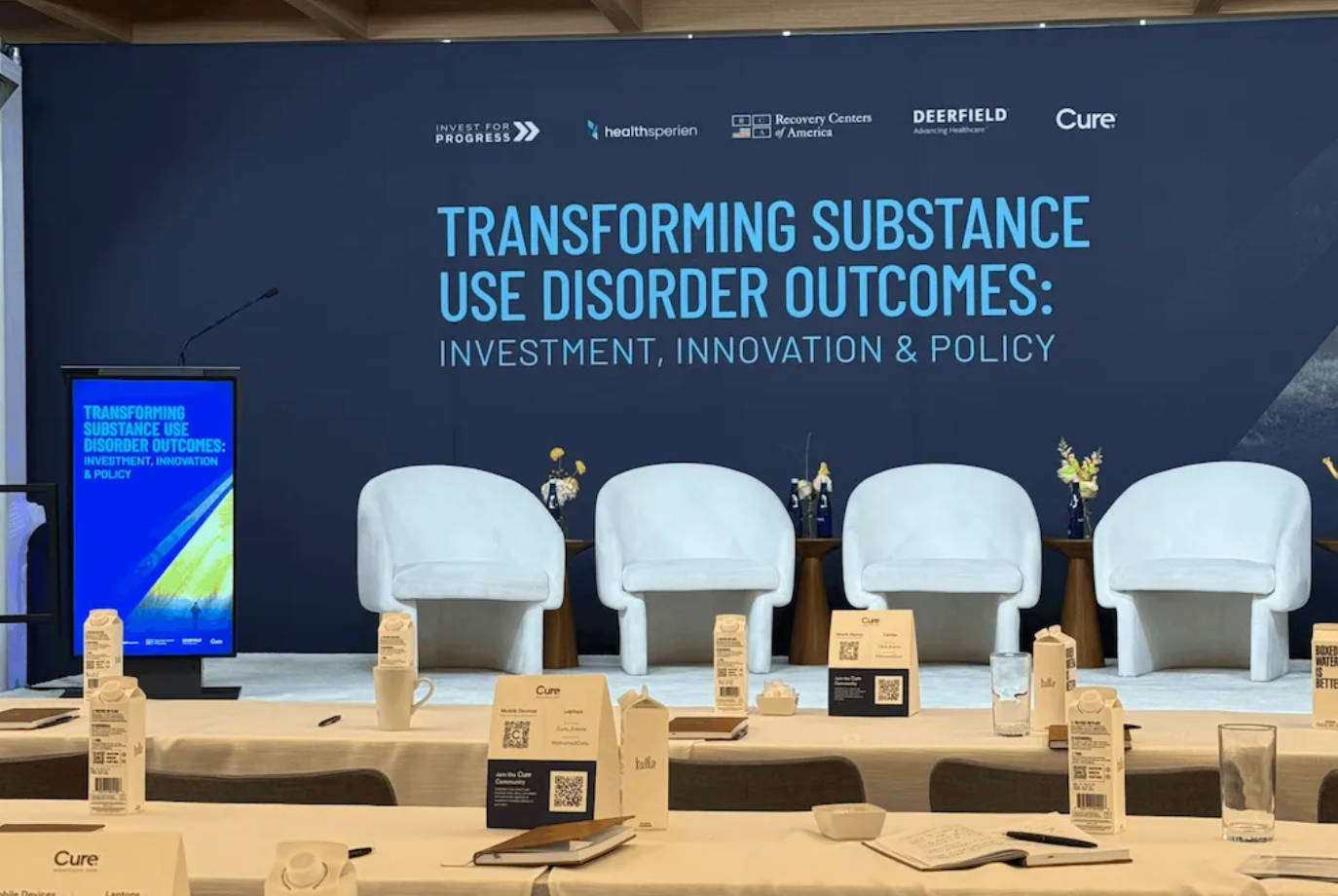
Patrick Kennedy and Kathryn Burgum of HHS opened the agenda by calling addiction a chronic condition still financed as a series of acute events. The federal panel that followed said CMMI's ACCESS model is adding SUD tracks that pay for outcomes, with CMS pushing Medicare Advantage and Medicaid managed care plans to follow.
We left the morning thinking about sequencing. Outcomes contracts will reward programs that can report retention, MOUD continuity and follow-up, and building that reporting takes staff and systems. Those get paid for out of today's fee-for-service revenue. A program losing a few points of collections to denials and underpayments is funding its outcomes work with money it never receives.
Clean fee-for-service billing is the bridge to value-based payment. The programs best placed for ACCESS-style contracts in a few years will be the ones collecting reliably on the claims they submit this year.
Utilization keeps getting counted as outcomes
On the models and evidence panel, Dr. Jason Kirby of Recovery Centers of America, Carter Paine of Wayspring and Bryan Cressey of Above & Beyond argued that length of stay and completion measure utilization, and that discharge should hand off to the next level of care. Wayspring reported about 60% lower medical costs for adherent MOUD patients, with payback in four to five months.
Our takeaway was that much of the most valuable SUD care happens between billable events. A care manager booking a psychiatry follow-up before discharge, a step-down from PHP to IOP and a post-discharge check-in all keep patients in treatment, and the panel was clear that payment rarely follows them across level-of-care lines.
Some of that work is truly unreimbursed today. Some of it is billable and gets lost because the visit isn't documented or coded in a way the payer will pay. We'd want every program to know which of its transition activities fall in which group, because the second group is revenue already earned.
What caught our attention was how short that payback is. With payer budgets running six to 12 months, a return inside one cycle sets up a very different conversation than the multi-year ROI the field usually points to.
Payers will reward the performance they can measure
On the MCO panel, moderated by Dr. Caroline Carney of Magellan Health, plans said they are paying for post-ED and post-hospitalization follow-up, care management PMPMs and rate increases for high performers. In Colorado, five MCOs and state Medicaid agreed on 10 shared quality measures, which panelists said cuts administrative load and makes providers more willing to accept insurance.
The Colorado example says a lot about where friction lives. When each payer asks for different measures and documentation, the cost of staying in-network rises, and some providers decide it isn't worth it. A shared measure set lowers that cost, and we'd expect other states to watch the results closely.
The rate increase lever stuck with us. Plans will reward performance they can verify, and the panel acknowledged that producing outcomes data at payer scale is still hard for many programs. Until shared measures and pooled data catch up, a program's claims history is its most complete record, and accurate capture of follow-up and transition visits is what makes that record useful.
Employers want SUD care moved in-network
On the employer panel, Anne Oxrider of Bank of America said more than 80% of SUD treatment across the bank's 400,000 covered lives is out of network, and the bank wants that care moved in-network. She also admitted, "We have no idea what we should be measuring."
The 80% figure stood out to us. A lot of SUD treatment has been paid out of network by large self-funded employers, and as employers push that care in-network, programs will be working with contracted rates, credentialing timelines and payer documentation rules instead. Programs that depend on out-of-network revenue would be smart to model what in-network rates mean for them now, and to find out which networks their patients' employers use.
Oxrider's comment on measurement reads to us as an opening. Employers don't yet know what to ask for, so providers who show up with follow-up adherence and retention data will help set the standard.
The rate underneath every outcomes contract
Most of the value-based payment we heard about still starts with a fee-for-service rate. Rate bumps for high performers are increases on a contracted rate. PMPMs and follow-up payments get added on top of the claims a program already submits. And when an employer moves patients in-network, those patients land in a contract with a negotiated rate for each level of care.
So the base rate matters more than it might seem, and in SUD it varies a lot. The same level of care can be paid very differently from one payer to the next, and even from one county to the next within a state. We've seen multi-state groups hold a rate that sits mid-market in one state and near the bottom in another.
After everything we heard, we expect many operators to be back at the table with payers sooner than they planned. Outcome data will take years to standardize. Rate data is available today, and it's the part of that conversation operators can prepare for now. Understanding where a contract sits against the market for each level of care, payer and county is where we'd start. It comes up often in our conversations with SUD operators, and in benchmarking their current rates we've seen how widely those contracts can vary.
The night before the conference, we hosted a dinner in New York City and had the chance to speak with SUD operators and leaders from across the space. We appreciated the time to connect and hear their perspectives ahead of the next day's sessions.

Where our thinking goes from here
One thread we kept coming back to is how much of the care SUD programs deliver never reaches a payer's view. Follow-up visits often go uncoded, MOUD retention goes unreported at many programs, and the staff time spent moving patients between levels of care rarely shows up on a claim. That gap costs programs revenue now and outcomes data later.
The payment model is also moving slower than the clinical one. Federal leaders, plans and employers all described SUD as chronic care, while nearly all of the money still flows through fee-for-service claims sorted by level of care. Programs will work in both systems for years, and the ones that do well will treat billing accuracy and outcomes reporting as the same data problem.
Taken together, the sessions describe a field where getting paid will soon depend on more than a clean claim. Payers want proof of performance, employers want care moved in-network, and outcome measures are working their way into contracts. Each of those shifts rests on the same foundation, which starts well before the claim with eligibility, benefits verification, credentialing and documentation, and ends with claims that reflect the full scope of care a program delivers. Programs that build that foundation now will have both the revenue and the record of results their next contract conversation will ask for.
Much of our work is helping providers get reimbursed for the care their patients rely on. Conversations like those at Invest for Progress, on access to care and how it’s funded, shape where that work goes next.