
The Payer Rate Negotiation Playbook: What Actually Moves a Commercial Rate
The 2026 economic environment makes it increasingly difficult for clinics to operate sustainably. Successfully increasing payer rates requires a deliberate strategy backed by the right data, timing, and a clear case for your value to the network.
10 min read
How Payers Actually Decide
This guide walks through how commercial payers actually decide on rate changes, where most requests go wrong, and how to build a proposal that gets evaluated instead of auto-declined. It applies to commercial payer contracts specifically. Medicaid and other state-administered plans set rates administratively, so a one-off negotiation usually isn't possible there.
A rate request isn't a conversation with one person. It's an input into a network adequacy model owned by an institution, and that distinction changes everything about how you should build your case.
The person who first reads your request, usually a Provider Relations Representative, has no pricing authority. Their job is to field and route requests, not approve them. Network Management or Contracting evaluates against defined criteria tied to network adequacy and cost impact at scale. The numbers that actually move the decision: providers like you per member, wait time for a first appointment, cost of members going out-of-network, single case agreement volume, complaints and grievances, and the cost to administer your contract.
Your job isn't to persuade a person. It's to give the payer better information about their own network than they currently have.
"No" Is the Default Response, and It's Not Personal
Payers say no by default, and there's a logical reason behind it, not a nefarious one. The cost of ABA care has risen sharply industry-wide, and payers are still figuring out how to keep the service line sustainable. Four reasons show up over and over:
Rate parity risk
Your increase sets a precedent. If it becomes known that asking works, other clinics ask too, and the payer's overall network cost rises without any gain in access or member benefit. The fix: tie your ask to specific drivers, not a blanket increase.
No access gap, from the payer's view
Based on their contract count across zip codes, the payer may believe their network is adequate even when your waitlist says otherwise. The fix: bring ground-level insight on demand and access constraints they can't see from their seat.
Utilization profile
Without context, your costs can look like inefficiency rather than a market reality. The fix: explain your utilization with data.
No rep authority
The person who receives your email can close the request. They can't approve it. The fix: follow the payer's actual structured process instead of relying on a relationship.
Speak the Payer's Language, Not Your Own
The most natural argument for a rate increase is also the weakest one: "our costs have increased." It's true, and it's still not an input into how a payer prices your contract. Rising costs can even signal inefficiency to them rather than a problem worth solving.
Here's how the common arguments actually land:
| The argument | Why it fails | Better approach |
|---|---|---|
| "Our costs have increased." | Payers don't price based on provider costs. | Focus on market need, access, and measurable value. |
| "We provide excellent care." | Quality claims are hard to evaluate without proof, and most payers don't have internal benchmarks for ABA quality. | Lead with measurable outcomes and data. |
| "Provider X gets paid more." | Creates a parity issue and can backfire. | Frame around market alignment, not matching another provider's rate. |
Take the other position. Every time you draft an argument about your own challenges, rewrite it as an argument about the payer's priorities.
Watch the full walkthrough, with examples and Q&A.
Three Levers That Actually Move Rates
Before writing your ask, identify which of these is genuinely your strongest case:
Access scarcity
You fill a gap the payer needs covered. Best for rural markets, underserved populations, language capabilities, in-home capacity. This is the strongest lever available, since network adequacy is a payer obligation, not a favor.
Administrative efficiency
You reduce the cost and complexity of working with you. Best for providers who can show cleaner claims and fewer administrative issues. This lever is underused today, and it's becoming more relevant as payers evaluate provider performance more closely.
Cost-of-care efficiency
You deliver better outcomes at a lower total cost, an apples-to-apples comparison of lifetime cost per client. Best for providers with claims, outcomes, or episode-cost data. Harder for smaller practices without measurement infrastructure in place.
Know Your Position Before You Ask
Read your contract first. This is a five-minute exercise that can recover revenue today. Check whether any rate escalators in your contract were actually applied, since many providers have them and never verify they were loaded. Check when and how you're allowed to request a rate change. Missing that window can delay an increase by a year.
Prioritize your payers, then build your case around the ones that matter most:
| Asset | What to know | Why it matters |
|---|---|---|
| Payer mix | Rank contracts by revenue, not frustration. | Focus where small gains have the biggest impact. |
| Rate benchmarks | Compare rates by CPT code, not blended averages. | Targeted asks are more likely to succeed. |
| Claims performance | Review denials, appeals, and AR by payer. | Strong performance strengthens your case; weak spots tell you where to prepare. |
| Access data | Measure waitlists, referral volume, and appointment availability. | Demonstrates unmet demand and network gaps. |
For access data specifically: segment it by payer instead of showing an aggregate waitlist. Measure time from referral to first session. Track declined referrals, especially capacity-related ones. Add zip-code or county-level detail. Show trends, since worsening access is a stronger argument than a static snapshot. And map your true service area using patient and waitlist zip codes, not just your clinic's address, since that's often where the real gap between coverage and demand shows up.
Rate Benchmarks by CPT and Payer. Illustrative only. All data shown is mock and for demonstration purposes. Actual contracted rates vary by payer, market, and contract terms.
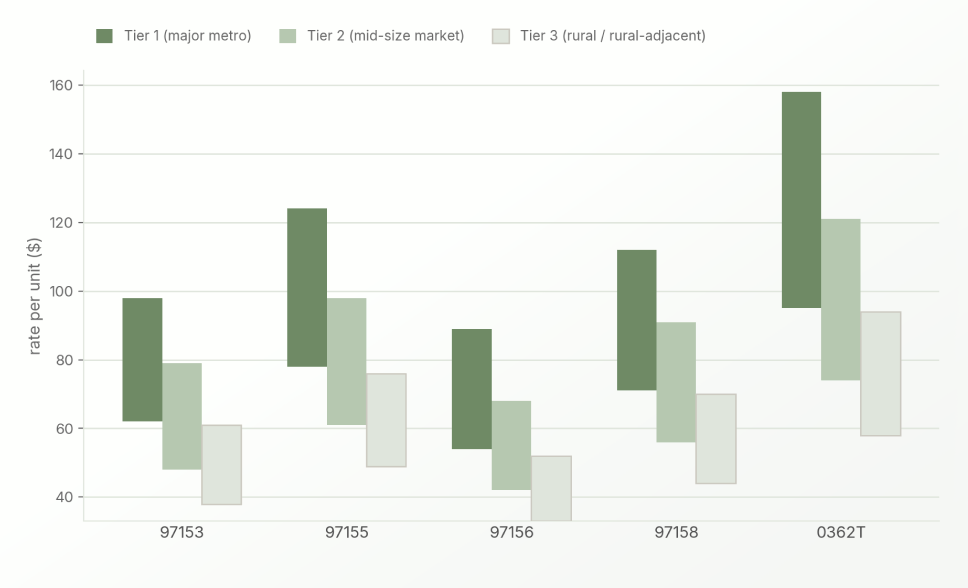
See how contracted rates vary across payers and CPT codes in your market with Camber's free Payer Rates Data tool.
Explore the Payer Rates Data toolBuild the Request Packet
Keep it to 2-3 pages, self-contained, with a single unambiguous ask stated early. Assume the reader has no prior context, and remember they may not be the one who decides. Their job is to decide whether it gets forwarded.
What to include:
- The ask - specific codes, rates, and effective date, on the first page
- Provider profile - locations, service area, staff, payer volume
- Business case - why the request makes sense
- Supporting data - access, claims, and market benchmarks
- Next steps - a requested response date and timeline
| Don't | Do |
|---|---|
| Start with a generic email | Read the contract first |
| Rely on your payer rep to make it happen | Follow the required process |
| Ask for a general rate review | Make a specific ask: code, rate, effective date |
| Ask for an across-the-board increase | Present a case based on specific criteria |
| Let the request stall | Set a response deadline |
Time It Around Events That Matter to the Payer
| Window | Why it matters | What to do |
|---|---|---|
| Contract renewal | The highest-leverage window for rate requests. | Submit before renewal and notice deadlines. |
| Budget planning | Rate changes are easier before budgets are finalized. | Ask when next year's network planning begins. |
| Regulatory changes | New adequacy or parity requirements create leverage. | Monitor state policy changes and use them in your case. |
| Payer changes | Leadership or market shifts can create openings. | Watch for organizational or competitive changes at the payer. |
If You Get a Conversation, Use It to Find the Real Blocker
A 20-minute call with a payer rarely ends in a yes on the spot. The goal isn't to convince them in the room. It's to uncover the real blocker and keep the door open.
"What's preventing this request from moving forward?" Use labeling to surface the real constraint and let them correct you, since the correction usually reveals the actual barrier: "It sounds like the issue is budget timing, not the request itself." Acknowledging their concerns directly builds trust: "Is it unreasonable to ask what the exception process looks like?"
Open the call by naming how you've already shown you're different: most payers get a dozen rate requests a month with no data behind them. Yours won't be one of them.
Don't End With Just a Rate Ask
Reimbursement is one lever. If the rate conversation stalls, these are worth putting on the table too:
- Credentialing speed - faster access to billable capacity
- Authorization changes - less admin burden, faster care delivery
- Directory accuracy - more referral visibility
- Escalation path - faster issue resolution
- Telehealth flexibility - more capacity, lower delivery costs
- Value-based models - upside tied to outcomes
The Work Pays Off Either Way
Even a partial win on rates leaves you with cleaner documentation, better utilization tracking, and a stronger position for the scrutiny payers are already increasing across the board. The preparation this playbook describes isn't just for the negotiation. It's the same groundwork every provider needs for what payers are asking of the network more broadly this year.
Run a free revenue audit with Camber to identify other opportunities that you can start actioning on today.